
Stats
- 10 Mission Posts
- 1 Personal Logs
Last Post
Wed Sep 9th, 2026 @ 12:54am
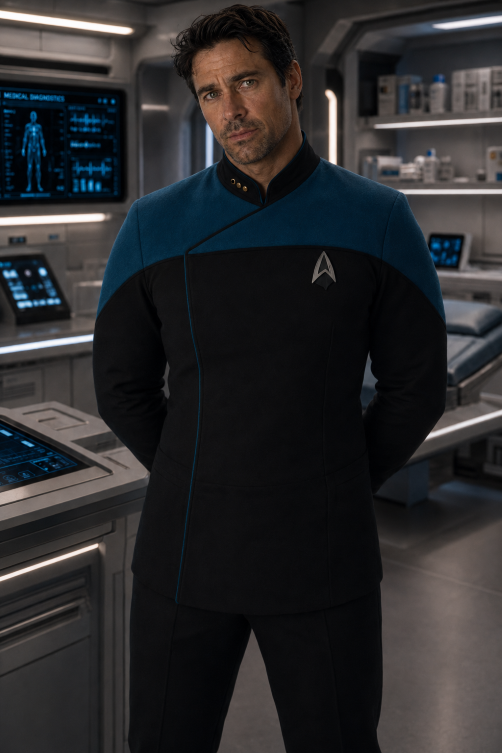
Lieutenant Commander Nathan Lake
Name Nathan Lake
Position Chief Medical Officer
Rank Lieutenant Commander
Character Information
| Gender | Male | |
| Species | Human | |
| Age | 37 |
Physical Appearance
| Height | 6’1 | |
| Weight | 200lbs | |
| Hair Color | Dark brown with subtle gray at the temples | |
| Eye Color | Hazel-green. They are both observant and emotionally heavy. | |
| Physical Description | Dr. Nathan Lake stands slightly over six feet tall with a well-built, athletic frame. He has dark brown hair with subtle gray at the temples. It’s unusually lightly unkept, often the result of long shifts in sickbay or sleepless nights. He has very observant hazel-green eyes that seem to study people from across the room. But there is a slight exhaustion under them that has yet to fade, though he carries himself pretty well. |
Family
| Spouse | Emily Lake (Deceased) | |
| Children | Sarah Lake (Deceased) | |
| Father | Daniel Lake (Deceased) | |
| Mother | Evelyn Lake (Deceased) | |
| Brother(s) | None | |
| Sister(s) | None | |
| Other Family | No other immediate family. |
Personality & Traits
| General Overview | Nathan Lake is a medical doctor with a little more than fifteen years of medical experience, including his Academy training and residency. Nathan lost both his wife and daughter in a shuttle accident, and that loss never fully left him. He turned inward and found refuge in the very things that keeps him motivated and interested - being a good doctor to his patients and saving lives. As a physician, Nathan is exceptional. His composure during intense situations is almost unnerving in the best possible way. He’s focused, precise, and unshakeable when the situation is catastrophic. He ensures he treats every patient with the same attentiveness, regardless of species, enemy, or friend, and crew members frequently find themselves opening up to him without issue. He’s very charming and listens without rushing to make you feel better, unless he has no choice, and people can really sense that. Although he considers himself a teaching doctor, Nathan can be a little funny, sarcastic, or spicy sometimes. He also has less patience for someone who is chronically inept. Sure, we all start as beginners and have to learn and training, but some people won't put in the work and feel they know better. It infuriates Nathan when he sees someone trying to pretend, to not put in the work. Off duty, Nathan gravitates toward things that make him feel alive. Such as gambling or whiskey and bourbon. When he has time on the holodeck, he goes over to an old bar he knows named McGuillicudies in Old New Paltz, NY. They have the best and strongest whiskies and bourbon he’s ever had in the Hudson Valley. For a softer, much less high-stakes hobby, he also enjoys collecting antique medical texts from all over the galaxy. These are some of the ways Nathan decompresses and stays tethered to the living. |
|
| Strengths & Weaknesses | Strengths: Nathan is a very talented doctor. He remains calm, focused, and precise. He has an impressive level of medical knowledge and training, which makes him ideal for any medical situation. Nathan listens without judgment. Crew members often find themselves opening up to him while receiving care. He is a doctor who knows when someone needs to be heard, not “fixed.” In high-stress situations, he can organize medical teams effectively and isn’t shy about thinking outside the box to develop unorthodox solutions. Weaknesses: Nathan rarely participates in recreational activities with others, especially in large groups. On occasion, yes, but not consistently. He finds himself awkward or out of place in these settings. It’s probably a symptom of his anxieties and emotional stresses. Also, even though he wants and loves to train less experienced people, he thinks he should carry the responsibility alone. It is something he is working on. Nathan is a workaholic. He pushes himself from time to time past the breaking point. This ties into feeling he alone bears the department's responsibility, as well as not wanting to lose anyone. It is another flaw he is trying to fix. |
|
| Ambitions | Nathan’s ambitions are deeply personal, even if he rarely admits it aloud. He no longer strives to gain recognition, promotion, or prestige. He would rather focus on doing the best job he can in making sure every day when he steps into the medical bay, he is focused on healing those who need care and teaching others, especially students or new officers, the importance of making a difference in peoples lives. | |
| Hobbies & Interests | Nathan’s current hobbies are: - Reading historical and old medical literature especially from other species. - Collecting antique medical texts. He prides himself of making his office and quarters into a small museum. - He plays fast and dangerous holodeck simulations to feel alive. - He’s really into high-stakes poker and other sorts of gambling. - He likes to visit the underground scene. - Whiskey and Bourbon tasting. - Goes on solo wilderness holodeck programs to get out of work and clear his mind. - Conduct Trauma medical research. |
| Personal History | Nathan Lake was born in 2364 in Halifax, Nova Scotia, Canada, on Earth. He was the only child of Daniel and Evelyn Lake. His father worked as a transport engineer, responsible for shuttling people between bases, while his mother served as a doctor specializing in neurological trauma care at Starbase 47. Nathan’s childhood was warm, loving, and intellectually rich. Although he loved both his parents, he became more attached to his mother, Evelyn, than to his father. Evelyn encouraged his curiosity from an early age, often allowing him to sit beside her as she reviewed medical journals and other medical texts. Though he was too young to fully process the graphic nature of many of the cases she studied, Nathan was fascinated by medicine long before he truly understood it. By adolescence, Nathan had developed an exceptional academic reputation. Teachers described him as highly intelligent, disciplined, and emotionally mature beyond his years. In 2381, at just 17 years old, Nathan would face his first internal challenge. He would lose both his parent due to illness. His father had developed an aggressive form of blood cancer, which rapidly deteriorated, and doctors were unable to do anything but make him feel comfortable in his last days. Evelyn loved her husband, Daniel, and was saddened by his loss. They were married for almost 40 years, and together they did almost everything. Losing him left an empty hole in her. Evelyn began to withdraw from society. She stood at home for long stretches of time. She didn’t speak to her friends and old colleagues. His mother’s mental health concerned Nathan, and he did his best to be present and available to her. As much as he missed his father, too, he needed to be strong for her. Unfortunately, a few months later, Evelyn succumbed to pneumonia after a short battle with the flu. This particular ailment would have been easily treated and cured, but she refused treatment and preferred to recover naturally. He was much closer to her than his father. And for a short time, he grieved for their loss. But they were both in their seventies, and Nathan knew it was just the natural circumstances of life. It is one certainty. That everyone dies eventually. And especially the way his career path formed in his head, this won’t be the first time he would experience death. At eighteen, Nathan entered Starfleet Academy in its medical track. His instructors quickly recognized that Nathan was talented. He has great composure under pressure and a strong combination of technical brilliance, emotional intuition, and calmness in training scenarios and during class projects. In his second year at the academy, one of the most enlightened moments occurred during an advanced simulation involving a massive shipwide casualty incident. The scenario presented a starship with hull breaches, fires, and failing systems. His medical teams became overwhelmed, so Nathan avoided the standard approach abandoned standard triage processes and instead completely decentralized medical ops. He ordered some non-medical sections of the ship and turned them into improvised, temporary medical centers. Though unconventional, the strategy saved lives. The incident earned Nathan a complicated reputation among instructors. Many felt he was brilliant under pressure, deeply compassionate, and willing to challenge convention when lives were at stake. Still, some instructors felt he was somewhat unconventional and potentially did things outside of normal medical practice. During his third year at the academy, Nathan formed a close friendship with a fellow cadet, Mira T’Sar, a Vulcan specializing in pediatrics and emergency medicine. Mira’s calm, logical personality balanced Nathan’s emotionally driven approach. The two spent a lot of time studying together, debating ethics, and participating in advanced medical simulations. While Nathan taught Mira the importance of emotional intuition in patient care, Mira helped Nathan understand the necessity of discipline and patience. To this day, they are good friends and write to each other consistently. Despite his successes, Nathan’s Academy years were not without failure. During his final year, he led a large-scale emergency medical systems project to improve coordination of medical responses. Nathan became obsessively invested in the project, pushing both himself and his team beyond healthy limits and beyond normal systems training. During final tests, he kept challenging the very system that he was using. Although he passed, his test results showed delayed response times due to second-guessing. He received heavy criticism from his fellow cadets and some professors. That experience hit Nathan pretty hard. Much harder than he publicly admitted. He understood that intelligence and determination alone could not solve every crisis. It forced him to learn the importance of trusting his team and accepting that, while painful, failure was sometimes unavoidable. In 2386, Nathan graduated from the Academy and, instead of a commission right away, entered Starfleet Medical, where he expanded his medical education across both broad and highly specialized fields. His primary areas of focus included Xenotrauma Surgery, Exobiology, Infectious Disease Medicine, and Large-Scale Battlefield Triage. He also pursued coursework in very niche areas, including undersea and hyperbaric medicine. He believed a physician should maintain as broad an understanding of medicine as possible. In 2388, something unexpected happened. Nathan met someone. A hotshot from Luna, Earth’s moon. She was young, ambitious, and one of the leading students in his advanced Neurology class. Her name was Emily Carter. Emily was a brilliant young aspiring physician, as well known among her peers for her giftedness as a researcher, sharp wit, and tendency to challenge instructors when she believed they were wrong. Nathan first noticed her during a heated debate over long-term neural regeneration therapies. Emily wasn’t content with established theories. Neither was Nathan. What began as disagreements with others became a team-up between two students who challenged ideas. It quickly became a conversation, then a friendship, and eventually something much deeper. At first, they bonded over their interest in medicine. Long nights studying together turned into dinners, and dinners became walks through the San Francisco Bay. Emily possessed an energy that perfectly balanced Nathan. Where he was quiet and introspective, she was confident and outspoken. Where he carried the weight of the world on his solitude, she had a way of reminding him that life was meant to be lived. For Nathan, who kept people at arm’s length, Emily became the first person since his mother whom he had ever truly allowed inside. Nathan completed his advanced studies in 2390 and received a commission as a Lieutenant Junior Grade (JG). Nathan was accepted on board the hospital ship USS Red Cross for his three-year medical residency. The Red Cross was a medical response vessel specializing in humanitarian relief, epidemic response, and general frontline medical support for any large-scale offensive or defensive operation. As they were also expecting their first child, they were married before his transfer to the Red Cross, and Emily took a year off to raise their daughter, whom they named Sarah. The years that followed were some of the happiest of Nathan’s life. Despite the challenges of service in Starfleet and long periods apart, the three of them remained inseparable. They exchanged daily messages, reviewed one another’s research, and spent time discussing many topics. During the first three years aboard the Red Cross, Nathan treated refugees displaced by border conflicts, victims of viral outbreaks, survivors of industrial disasters, and civilians caught in environmental catastrophes. In addition to normal internal medicine for the crew on board. What shocked Nathan most was realizing that, despite the Federation’s technological advances, countless people across the outer worlds and outer colonies lacked access to medical care. It wasn’t so much access to any care, it was more when there was an emergency, as there wasn’t enough care to go around. Resources were often stretched dangerously thin. He completed his residency in 2394, was promoted to full Lieutenant, and remained on board the ship for an additional year. He was assigned the role of Assistant Chief Medical Officer in the Infectious Disease Unit. In 2395, right before a transfer to the USS Event Horizon, a deep-space exploratory and rapid-response ship assigned to unstable regions along the edges of Federation space, and with the role of its Chief Medical Officer, tragedy struck. Emily and Sarah were both killed in a shuttle crash. The accident broke Nathan. Understandably, he was given a bereavement, and he was away for three months grieving and coping with in-laws, psychologists, and counselors. Initially, he became quiet, withdrawn, and emotionally isolated. But as time progressed, he slowly recovered. It was yet another deep loss for him. Something he knew he might not recover from. Until one day, he found a letter Emily had written for Nathan back when they were in advanced studies. The positive, loving, and full-of-life moments in the letter reminded him that he was professionally special and that he had chosen his profession wisely. Nathan is a very talented doctor whose mind and skills were needed in the darkness of places. Nathan would decide to bury his hurt and grieve in his own way. Psychologists and counselors cleared him to return to active duty. The truth was, he had learned how to hide his grief exceptionally well. Not that it was completely gone. Nathan finally joined the Event Horizon as its Chief Medical Officer and was happy for it. For the first time, Nathan carried responsibility not only for his patients but also for an entire medical department, all while advising senior command staff during emergencies. There was intense pressure, but Nathan was up for the challenge. Medicine became the center of his life. Nathan developed the belief that if he dedicated himself to healing others, perhaps fewer people would have to endure the kind of loss he had suffered. And in turn, it would allow him to heal. However, the assignment also exposed him to some intense experiences. During a catastrophic colony evacuation involving the collapse of critical infrastructure, Nathan and his medical staff became overwhelmed by the casualty numbers. Nathan was unable to save hundreds of civilians despite exhausting available resources and medical manpower. Though Starfleet later commended his leadership and medical response under impossible circumstances, the event left him emotionally devastated. However, on a positive note, everyone worked as a team and trusted each other, without that, more lives could have been lost. In early 2398, the USS Event Horizon was operating near the former Federation/Romulan Neutral Zone when it came under sudden attack by a rogue Romulan warband that was part of the surviving elements of the old Tal Shiar intelligence apparatus. They are now made up of former Romulan military hardliners and displaced commanders who refused to accept the political fragmentation that followed the collapse of the Romulan Empire after the destruction of Romulus decades earlier. The battle lasted nearly an hour but resulted in the ship’s destruction. Escape pods were launched, and rescue operations began across the debris field. Nathan lost three members of his medical staff during the attack, but nearly half of the ship’s crew perished. In recognition of his extraordinary medical performance during the evacuation, with exceptional leadership and courage under fire, Nathan and several surviving officers received commendations from Starfleet Command. Additionally, Nathan was promoted to Lieutenant Commander and offered a choice between a prestigious assignment at Starfleet Medical or a transfer to another vessel. Nathan chose the latter, believing his duty was not simply to heal, but to serve, protect, and stand beside those in danger. He couldn’t do that while sitting behind a desk or standing at a podium. He accepted the transfer orders to the USS Resolute as its new Chief Medical Officer. |
|
| Service Record | 2364: Born in Halifax, Nova Scotia 2382–2386: Starfleet Academy, Medical Track 2386–2390: Starfleet Medical 2390: Commissioned as Lieutenant Junior Grade 2390–2393: Medical Officer (Residency), USS Red Cross, 2393–2394: Assistant Chief Medical Officer, Infectious Disease Unit, USS Red Cross; promoted to Lieutenant 2394–2397: Chief Medical Officer, USS Event Horizon 2397: Promoted to Lieutenant Commander for actions taken during the Romulan incident 2398–Present: Chief Medical Officer, USS Resolute |