
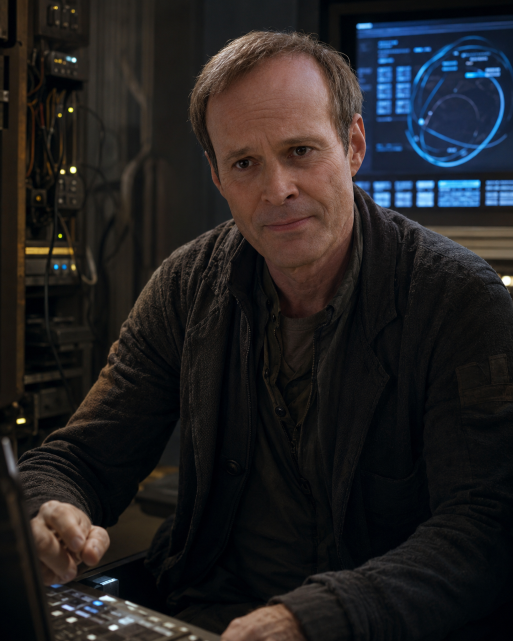
Reginald Barclay III
Name Reginald Endicott Barclay III
Position Pathfinder Relay Coordinator
Character Information
| Gender | Male | |
| Species | Human | |
| Age | 58 |
Physical Appearance
| Height | 6' 1" | |
| Weight | 181 lbs | |
| Hair Color | Brown | |
| Eye Color | Brown, greying | |
| Physical Description | Reginald Barclay is a tall, lean man with brown eyes and thinning brown hair that has greyed noticeably with age. By 2398, he carries the worn look of someone who has spent too many years hunched over consoles, relays, and half-dead Starfleet systems, though there is still a nervous sharpness to him. His posture can seem awkward or hesitant at first, but there is a quiet focus in his expression when he is working, the kind that suggests his mind is always several steps deep inside the machinery. |
Family
| Spouse | Elise Hartwell (Deceased) | |
| Children | Mira Barclay (Alive, age 21) | |
| Father | Reginald Endicott Barclay II (Deceased) | |
| Mother | Alicia Barclay (Deceased) |
Personality & Traits
| General Overview | Reginald Barclay is an anxious, intensely intelligent man whose nervous habits often obscure just how capable he truly is. He second-guesses himself, overexplains when pressured, and can retreat into technical detail when emotions become too much, but beneath that uncertainty is a deeply compassionate and loyal officer who keeps showing up even when fear has both hands around his throat. He is not naturally bold, but his courage is stubborn rather than dramatic. Barclay notices what others miss: small inconsistencies, hidden risks, broken systems that can still be made useful. Years of occupation and Lantern work have made him more guarded, but not colder. If anything, they have sharpened his empathy. He understands frightened people because he has spent most of his life being one. By 2398, Barclay carries himself with more quiet weight than he once did. He is still awkward, still prone to panic spirals, still more comfortable with machinery than with crowds, but there is resilience in him now. He has learned that bravery does not always look clean or confident. Sometimes it looks like a trembling man staying at the console because someone, somewhere, needs the signal to get through. |
|
| Strengths & Weaknesses | Strengths Reginald Barclay possesses an exceptional technical mind, particularly in communications systems, relay architecture, holography, encryption work, and unconventional systems repair. He has a rare ability to see patterns inside broken or fragmented technology, allowing him to turn damaged infrastructure, corrupted relay traffic, obsolete protocols, and half-dead Starfleet systems into something useful. His anxiety often makes him cautious, but that caution can become an asset in covert work, as he tends to notice risks others overlook. He is loyal, persistent, deeply compassionate, and far braver than he usually believes himself to be. When given time, trust, and a problem worth solving, Barclay can achieve things that more confident officers might dismiss as impossible. Weaknesses Barclay continues to struggle with anxiety, self-doubt, and a tendency to retreat inward when overwhelmed. He can overthink decisions, fixate on small details, or become paralysed when forced into direct confrontation without preparation. His social awkwardness sometimes makes it difficult for others to recognise his competence quickly, and years of occupation and covert resistance work have only deepened his instinct to isolate himself. He also carries a heavy burden of guilt, especially over those he could not save and the risks his work creates for people connected to him. While he is capable of courage, it rarely comes easily; every brave act costs him something, even when he hides it behind nervous hands and technical chatter. |
|
| Ambitions | Barclay wants to keep the Lantern Network alive long enough for the scattered pieces of Starfleet to find each other again. More personally, he wants to give his daughter a future that is more than curfews, fear, false broadcasts, and hidden rooms. He does not dream of glory or command; he wants the quiet miracle of safe signals, living friends, and one day being able to speak openly without wondering who is listening. | |
| Hobbies & Interests | Barclay has always found comfort in holoprogramming, especially when creating complex environments that allow him to think through problems safely before facing them in reality. He enjoys tinkering with old Starfleet equipment, restoring obsolete systems, and building strange little technical workarounds that no one else would have the patience to understand. He also has a quiet fondness for classical theatre, music, and immersive historical simulations, though in the Avalon timeline even those comforts are often repurposed into encrypted training spaces, hidden archives, or private places where he can breathe for a while. |
| Personal History | Reginald Endicott Barclay III was born in 2340, the only child of Reginald Endicott Barclay II and Alicia Barclay. From an early age, he was intelligent, imaginative, and technically gifted, though never especially comfortable around other people. Machines made more sense to him than crowds did. Systems had logic. Circuits had causes. People, with all their unspoken expectations and social currents, were far more difficult to predict. His childhood and adolescence shaped a man who often retreated inward when overwhelmed. Barclay’s imagination became both refuge and prison, giving him a place to feel capable when the outside world made him feel exposed. That instinct followed him into Starfleet. At the Academy, he proved himself a talented engineer with a strong grasp of diagnostics, communications theory, and holotechnology, but he struggled with confidence, social integration, and the pressure of being judged by his peers. His early service aboard the USS Zhukov reflected that tension. Barclay was capable, diligent, and technically sharp, but he was also nervous, hesitant, and often misunderstood. His transfer to the USS Enterprise-D became one of the most important turning points of his life. At first, he found it difficult to function among such a famously accomplished crew. His anxiety, holodeck dependency, and social awkwardness nearly undermined his career, but the support of officers such as Geordi La Forge and Deanna Troi helped him begin the slow, uneven work of trusting himself. Barclay never became effortlessly confident, and perhaps that was the point. His courage was never loud. It arrived with trembling hands, too many words, and the stubborn refusal to give up once someone needed him. During his time aboard the Enterprise-D and later the Enterprise-E, he grew into a more reliable officer, one whose technical instincts could be extraordinary when allowed room to breathe. His experiences with the Borg during the events surrounding First Contact left a deep mark on him, worsening old fears while also sharpening his understanding of what it meant to face something vast, invasive, and dehumanising. Following his time aboard the Enterprise, Barclay’s expertise drew him into Starfleet’s long-range communications research. His work on the Pathfinder Project became one of his defining achievements. What began as a desperate attempt to reach Voyager across impossible distance became proof that Barclay’s peculiar mind could see pathways where others saw only silence. Pathfinder gave him purpose, and for a time, it gave him hope. In the Avalon timeline, that hope was savagely interrupted. The Federation’s collapse, the fall of Earth, and the Dominion occupation changed Barclay’s life entirely. He was not built for war in the traditional sense. He was not a soldier in the streets or a commander giving speeches from hidden bunkers. Yet the very qualities people had once dismissed in him became invaluable. He understood concealment. He understood fear. He understood how to hide important things in plain sight. After the fall, Barclay began preserving fragments of Pathfinder research inside damaged Starfleet infrastructure, corrupted relay traffic, maintenance protocols, and forgotten communications systems. At first, it was survival work, a way of keeping scattered Starfleet remnants from losing one another completely. Over time, those hidden pathways became part of something larger: the early skeleton of the Lantern Network. Barclay’s work became especially vital when Voyager returned to the Alpha Quadrant and found not the Federation it had expected, but a broken civilisation under Dominion rule. His buried Pathfinder-derived protocols allowed Voyager’s identity to be verified without exposing the ship to Dominion detection, making him one of the first secure links between Janeway’s crew and the growing Lantern resistance. This role is already established in the Avalon timeline, where his hidden communications work helps connect Voyager to Lantern contacts after its return. Somewhere amid those years of fear and coded signals, Barclay also found something deeply personal. He met Elise Hartwell, a civilian communications engineer whose patience, intelligence, and quiet steadiness reached him in ways few people ever had. Their relationship was not simple or storybook-perfect; Barclay was still Barclay, full of nerves, doubts, and awkward retreats. But Elise understood the language of broken systems and frightened people. She became one of the few people who could sit beside him in silence and make the world feel less hostile. Their daughter, Mira Barclay, was born in 2377, during the early years of Dominion occupation. Her birth changed Barclay’s understanding of fear. Before Mira, fear had often driven him inward. After her, it drove him forward. Every hidden relay, every encrypted pulse, every dangerous backdoor in Dominion-monitored traffic became part of a larger promise: that his daughter might one day inherit something better than checkpoints, propaganda, curfews, and whispered names. Elise’s death hardened something in him, though not in the obvious way. Barclay did not become cold, fearless, or vengeful. He remained anxious, awkward, and painfully aware of everything that could go wrong. But after losing her, he became more determined. His work for the Lantern Network was no longer simply technical duty. It became grief with a purpose, love translated into signal architecture, resistance carried through the smallest possible spaces between Dominion surveillance sweeps. By the 2390s, Barclay had become one of the Lantern Network’s most important unseen figures. Few knew his location. Fewer still understood the full scope of what he maintained. To most resistance cells, he was only a codename, a rumour attached to impossible messages that arrived just before raids, evacuation windows, or Dominion traps. To those who knew better, he was Pathfinder: the man who kept the scattered lights talking. By 2398, Barclay remains a covert Starfleet and Lantern operative, his location classified and his work essential to the resistance. He is still nervous. Still prone to self-doubt. Still more comfortable with relays than rooms full of people. But the years have carved resilience into him. He has survived the loss of the Federation, the death of the woman he loved, the danger surrounding his daughter, and the crushing knowledge that every signal he sends could save lives or doom them. He does not see himself as a hero. He probably never will. But across occupied space, in hidden rooms and half-powered ships, people still hear one another because of him. And in the dark, that is close to a miracle. |
|
| Service Record | 2358–2362: Starfleet Academy, Engineering track 2362–2366: Systems Diagnostic Engineer, USS Zhukov 2366–2371: Systems Diagnostic Engineer, USS Enterprise-D 2371–2373: Holoprogramming and Systems Specialist, Starfleet Technical Assignments / Jupiter Station 2373–2374: Engineering Officer, USS Enterprise-E 2374–2375: Communications Research Specialist, Starfleet Command / Pathfinder Project 2375: Detached from standard Starfleet operations following the fall of Earth and the collapse of Federation command structure 2375–2378: Operated through covert Starfleet and civilian channels, preserving fragments of Pathfinder research within corrupted relay traffic, hidden maintenance protocols, and damaged Starfleet communications infrastructure 2378–2384: Lantern-linked communications engineer and covert Voyager liaison, helping verify Voyager’s return and establish secure contact between the ship and early Lantern Network contacts 2384–2392: Senior Relay Architect, Lantern Network, assisting in the expansion of hidden communications routes across occupied space 2392–2398: Lantern Network Communications Architect, maintaining covert Pathfinder-derived relay systems and supporting secure communications between resistance cells, concealed vessels, and senior Lantern operatives Final Known Starfleet Rank: Lieutenant Commander Lantern Network Codename: Pathfinder Current Effective Role: Lantern Network Communications Architect, responsible for designing, maintaining, and concealing the covert relay infrastructure that allows Lantern cells, hidden Starfleet remnants, and allied resistance contacts to communicate without drawing Dominion attention. |