
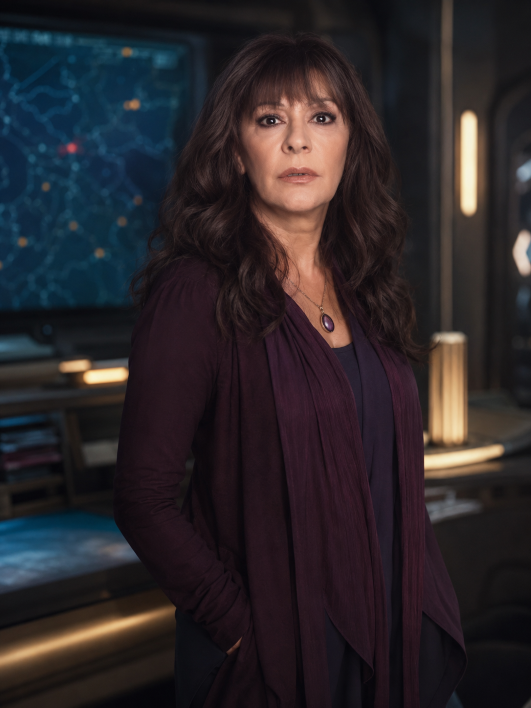
Deanna Troi
Name Deanna Troi
Position Lantern Psychological Liaison
Character Information
| Gender | Female | |
| Species | Betazoid/Human | |
| Age | 62 |
Physical Appearance
| Height | 5' 3" | |
| Weight | 130 lbs | |
| Hair Color | Dark Brown | |
| Eye Color | Black | |
| Physical Description | Deanna is a petite woman with dark brown hair and the distinctive black eyes of her Betazoid heritage. Her features are expressive and naturally warm, with a calm, composed presence that often makes people feel seen before she has said very much at all. Though the years of occupation and resistance have left their mark, she carries herself with quiet grace rather than fragility, balancing Starfleet poise with the softer emotional awareness that has always defined her. |
Family
| Spouse | William T. Riker | |
| Children | Thaddeus Troi-Riker, Kestra Troi-Riker Family Notes: Deanna and Will’s family remained one of the few private anchors in a life increasingly consumed by the Lantern Network and resistance work. |
|
| Father | Lieutenant Ian Andrew Troi (Deceased) | |
| Mother | Lwaxana Troi (Deceased) | |
| Sister(s) | Kestra Troi (Deceased) - Deanna’s older sister, who died in childhood following a drowning accident. | |
| Other Family | Mr. Homn, long-serving attendant and close household companion to Lwaxana Troi (Deceased) |
Personality & Traits
| General Overview | Deanna Troi is calm, perceptive, and deeply compassionate, though the years of occupation have made that compassion more guarded than it once was. She has always been someone who listens before she speaks, taking in the emotional shape of a room and noticing the fears people try to hide behind discipline, anger, humour, or silence. Her warmth is still genuine, but it is no longer naïve; she understands how easily trust can be exploited, and she has learned to balance kindness with caution. Within the Lantern Network, Deanna is often a quiet stabilising presence. She does not need to dominate a briefing to influence it, and her authority comes less from command presence than from the weight of her judgement. People tend to confide in her because she makes them feel seen without making them feel exposed. She is patient, emotionally intelligent, and skilled at guiding frightened or traumatised people back towards clarity, even when the world around them is doing everything it can to keep them broken. The Dominion’s occupation has sharpened her. Deanna remains gentle where gentleness is needed, but she is no longer afraid to be firm, direct, or even cold when lives are at stake. She has little patience for cruelty disguised as pragmatism, and she will challenge Will or any other Lantern contact if she believes a decision risks turning the network into the very thing it is fighting. Her moral centre is one of her defining traits, not because she refuses hard choices, but because she insists those choices still have a cost. As a wife and mother, Deanna carries a private tenderness that the war has never managed to strip from her. Her family is both her greatest vulnerability and her strongest anchor. She feels loss deeply, especially the loss of Betazed’s safety, her mother, and the old Federation future her children should have inherited, but she does not allow grief to consume her. Instead, she turns it into purpose. To those who know her well, Deanna is not simply “The Listener” because she hears emotion. She is The Listener because she remembers the person inside the soldier, the refugee, the informant, the prisoner, and the commander who has forgotten how tired he is. |
|
| Strengths & Weaknesses | Strengths Deanna’s greatest strength is her ability to understand people beneath the surface. Her empathic sense, counselling experience, and years of Starfleet service make her highly skilled at reading fear, grief, loyalty, coercion, and emotional instability before they become operational risks. She is calm under pressure, deeply compassionate without being naïve, and often serves as a quiet stabilising force within the Lantern Network, helping others remain human in a war designed to strip that away. Weaknesses Deanna can carry too much of other people’s pain, especially in a resistance environment where trauma is constant and hope is rationed like medicine. Her compassion can make certain decisions harder, particularly when protecting the wider network means abandoning individuals she believes could still be saved. She is also not a front-line combat specialist in the same way as many Lantern operatives, relying more on judgement, emotional intelligence, and experience than direct tactical force. |
|
| Ambitions | Deanna’s ambition is to help keep the Lantern Network alive without allowing it to lose its compassion, trust, or sense of purpose. More personally, she hopes to see a future where her family and the scattered worlds of the former Federation no longer have to survive in shadows. | |
| Hobbies & Interests | Deanna has always found comfort in quieter, reflective pursuits, especially music, language, meditation, and the cultural traditions of Betazed. In the rare moments where the Lantern Network allows her to step away from duty, she gravitates toward anything that helps restore emotional balance, whether that is sharing tea, reading, listening to old recordings, or simply sitting in silence with someone who needs not to be alone. She also has a deep appreciation for family life and familiar rituals, holding onto small acts of normality as a quiet form of resistance. Cooking with her family, preserving memories of Betazed, and maintaining personal connections matter to her because they remind her what the Lanterns are actually fighting to protect. |
| Personal History | Deanna Troi was born on Betazed in 2336, the daughter of Betazoid Ambassador Lwaxana Troi and Human Starfleet officer Lieutenant Ian Andrew Troi. Her early life was shaped by both privilege and loss. Through her mother, Deanna belonged to the Fifth House of Betazed, with all the ceremony, expectation, and very particular force of nature that came with Lwaxana Troi’s world. Through her father, she inherited a quieter Human influence, one rooted in Starfleet service, duty, and emotional restraint. His death while Deanna was still young left a lasting mark on her, as did the later discovery of the truth surrounding her older sister Kestra, whose childhood death had been buried beneath grief and family silence. Growing up between two cultures gave Deanna a deep awareness of identity, belonging, and emotional complexity. As a Human-Betazoid hybrid, she did not possess the full telepathic abilities of many Betazoids, but her empathic sense developed strongly. She learned to read emotion, intention, fear, grief, affection, and deception in ways that made people difficult to ignore and even harder to dismiss. Rather than allowing that sensitivity to overwhelm her, Deanna trained herself to understand it, eventually choosing a path that combined psychology, counselling, diplomacy, and Starfleet service. After entering Starfleet, Deanna specialised in counselling and psychological support, bringing her empathic abilities into a professional framework. Her assignment to the USS Enterprise-D placed her among some of the most influential officers of her generation. As ship’s counsellor, she served not only as a mental health professional, but as a senior advisor to Captain Jean-Luc Picard, frequently assisting with diplomatic encounters, first contact situations, crew welfare, and moments where emotional insight proved as vital as tactical analysis. Her years aboard the Enterprise helped shape her into a composed, perceptive, and quietly resilient officer. During her time aboard the Enterprise-D and later the Enterprise-E, Deanna faced crises that tested both her compassion and her strength. She endured alien manipulation, personal trauma, Borg encounters, loss, and war, yet remained committed to the idea that emotional honesty and trust were not weaknesses. Her relationship with William T. Riker had long been one of the defining constants of her adult life, even when duty, pride, timing, and circumstance kept them from choosing the simpler path. Their bond survived the Enterprise, war, loss, and years of uncertainty before finally becoming something neither of them could afford to keep at arm’s length any longer. When the Dominion War turned catastrophic and the Federation began to fracture, Deanna’s role changed. By 2375, she and Will had been detached from the Enterprise-E on a covert assignment connected to Starfleet Intelligence and the earliest resistance contacts. That decision saved them from the destruction of the ship during the defence of Sector 001, but it also cut them away from much of the life they had known. With Earth occupied, Starfleet shattered, and the Federation formally broken, Deanna became part of the hidden architecture of survival that would eventually grow into the Lantern Network. In the years after the Federation’s collapse, with Starfleet broken and the old future stolen from them, Deanna and Will married not as an escape from the war, but as an act of stubborn hope within it. Their children, Thaddeus and Kestra Troi-Riker, became the private centre of Deanna’s life during a time when almost everything else had been consumed by occupation, secrecy, and resistance work. Motherhood changed the way she understood the cost of the Lantern Network’s fight. Every refugee child, every frightened parent, every family torn apart by Dominion policy carried a sharper meaning for her because she knew exactly what it was to love something the Dominion could use against you. Her family did not soften her resolve; it gave that resolve a face, a voice, and a reason to endure. The loss of her mother, Lwaxana, added another deep wound to those years. Their relationship had always been complicated, full of love, frustration, ceremony, theatrical excess, and an intimacy that only Lwaxana could make both overwhelming and irreplaceable. Losing her meant losing one of Deanna’s strongest living ties to Betazed, the Fifth House, and the fierce, impossible strength of her maternal line. In the years after Betazed’s occupation and the suffering of its telepathic communities, that grief became tangled with duty, memory, and the need to preserve what the Dominion tried to break. As the occupation deepened, Deanna’s skills became increasingly important to the resistance. She worked with displaced Starfleet personnel, Betazoid underground contacts, refugee routes, and traumatised civilians who had survived occupation, interrogation, collaboration, and loss. Her empathic abilities made her useful, but it was her judgement that made her trusted. She learned how fear could be used as a weapon, how coercion could twist decent people into informants, and how resistance cells could destroy themselves from within if grief, suspicion, and exhaustion were left unchecked. As the Lantern Network developed, Deanna became known by the codename The Listener. She was not the network’s military commander, nor did she seek formal control over its operations. Instead, she became one of its most vital stabilising figures, advising on cell integrity, contact assessment, trauma recovery, morale, and Dominion psychological tactics. Where Will Riker became a symbol of defiance and strategic resistance, Deanna became the quieter force ensuring the Lanterns remembered why they were fighting in the first place. By 2398, Deanna Troi remains one of the Lantern Network’s most trusted senior figures. Years of occupation have changed her, sharpening her compassion into something more disciplined and wary, but they have not broken it. She continues to serve as the Lantern Psychological Liaison, helping keep operatives, refugees, and resistance cells alive not only in body, but in spirit. In a quadrant where the Dominion has turned trust into a battlefield, Deanna’s work remains essential: listening, guiding, protecting, and reminding the Lanterns that survival without humanity is only another kind of surrender. |
|
| Service Record | 2355–2359: Starfleet Academy, Command/Counselling track 2359–2364: Starfleet Medical / Advanced Counselling and Psychology Training 2364–2371: Ship’s Counsellor, USS Enterprise-D 2371–2372: Counsellor, USS Enterprise-E 2372–2375: Counsellor and senior officer, USS Enterprise-E 2375: Detached from the Enterprise-E with Commander William T. Riker on covert Starfleet Intelligence assignment linked to early resistance contacts 2375–2378: Operated through covert Starfleet and civilian channels following the fall of Earth and the dissolution of the Federation 2378–2391: Assisted in the development of early Lantern-linked support routes, particularly involving Betazoid resistance circles, refugee networks, and traumatised former Starfleet personnel 2392–2398: Lantern Network Psychological Liaison, working alongside Will Riker and senior Lantern contacts to support cell integrity, morale, trauma recovery, contact assessment, and resistance welfare across occupied space Final Known Starfleet Rank: Commander Lantern Network Codename: The Listener Current Effective Role: Lantern Psychological Liaison, supporting resistance morale, trauma recovery, contact assessment, and protection against Dominion coercion tactics. |