
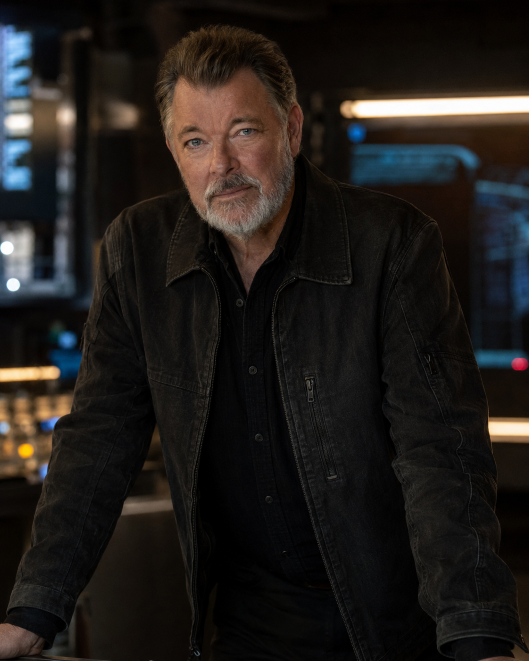
Admiral William Riker
Name William Thomas Riker
Position Leader of the Network
Rank Admiral
Character Information
| Gender | Male | |
| Species | Human | |
| Age | 63 |
Physical Appearance
| Height | 6'4" | |
| Weight | 235 lbs | |
| Hair Color | Brown, greying. | |
| Eye Color | Blue | |
| Physical Description | William Riker remains a physically imposing man even into his sixties, tall and broad-shouldered with the solid build of someone who has spent a lifetime in command chairs, crisis zones, and the occasional fight he absolutely did not start. His posture still carries that old Starfleet confidence, though it has become quieter with age, less swagger and more weight. He has greying brown hair, a neatly kept beard that has silvered with the years, and clear blue eyes that can still warm with humour when he lets them. His face has weathered since the fall of the Federation, marked by age, fatigue, and old grief, but the familiar Riker presence remains unmistakable: commanding, human, and difficult to ignore. |
Family
| Spouse | Deanna Troi-Riker Former Starfleet counsellor and covert Lantern Network operative. |
|
| Children | Thaddeus “Thad” Troi-Riker and Kestra Troi-Riker, both kept out of public records after Riker and Troi disappeared into the Lantern Network. | |
| Father | Kyle Riker (deceased) | |
| Mother | Betty Riker (deceased) | |
| Brother(s) | Duplicate: Thomas Riker (status unknown) | |
| Other Family | Mother-in-law: Lwaxana Troi (deceased) Father-in-law: Ian Andrew Troi (deceased) Sister-in-law: Kestra Troi (deceased) |
Personality & Traits
| General Overview | William Riker remains recognisably himself: warm, confident, charming when he chooses to be, and still carrying that easy command presence that once made him one of Starfleet’s most respected first officers. He is a natural leader rather than a bureaucratic one, someone who understands people before he understands systems, and who can make a frightened courier, a former Starfleet captain, a smuggler, or a traumatised civilian feel as though they still matter. The years have not taken away his humour or his humanity, but they have weathered both. His smile comes a little slower now, and when it does, it often carries grief behind it. Riker has always had a bold streak, but age and loss have refined it into something quieter and more deliberate. He is still willing to gamble when the stakes demand it, though he no longer enjoys the thrill of the risk the way he once might have. Every decision now carries faces with it: Picard, the Enterprise-E, friends lost to the war, people taken by the Dominion, and those he could not get out in time. He has learned to live with impossible choices, but not to make peace with them. That distinction matters. It is one of the things that keeps him from becoming cold. As “The Admiral”, Riker has become part man, part rumour, and part resistance myth. He dislikes the title in principle, since he never held the rank and never wanted to pretend otherwise, but he understands why people use it. In occupied space, hope often needs a name before it can become action. To those inside the Lantern Network, he is steady, pragmatic, protective, and deeply loyal, but not soft. He expects courage, honesty, and discipline from those who work with him, and he has little patience for ego when lives are at stake. His love for Deanna and their children remains the private centre of his life. It grounds him, frightens him, and gives him something the Dominion can never be allowed to touch. He is protective of his family, sometimes to a fault, but not possessive; he trusts Deanna as his equal in every meaningful sense. Their partnership is one of the reasons the Lantern Network has survived as long as it has. Where Riker reads strategy, morale, and opportunity, Deanna reads fear, coercion, grief, and the fragile places where people either break or become brave. Beneath the command voice and old Starfleet confidence, Riker carries survivor’s guilt that he rarely speaks of plainly. The loss of the Enterprise-E, Picard’s death, Data’s capture, and the collapse of the Federation left him with wounds that never had time to heal properly. He does not wallow in them, and he would reject pity outright, but they shape him. He is slower to judge failure now, more attentive to hidden grief, and far less interested in clean heroic narratives. Survival, to Riker, is often ugly, improvised, and morally exhausting, but still worth fighting for. By 2398, Riker is no longer the ambitious officer waiting for his own command. He has become something stranger and harder to define: a commander without a fleet, an admiral without a rank, a father hiding his children from an empire, and a Starfleet officer keeping the idea of Starfleet alive long after its institutions were broken. He is still William T. Riker, but the years have stripped away the shine and left the iron underneath. |
|
| Strengths & Weaknesses | Strengths William Riker is an experienced command officer with decades of Starfleet service behind him, shaped by crisis leadership, deep-space diplomacy, combat, first contact situations, and years spent as Jean-Luc Picard’s right hand aboard the Federation’s flagship. He has a natural gift for reading a room, understanding people quickly, and knowing when to charm, challenge, or command. Even after the fall of the Federation, he remains adaptable, tactically sharp, and capable of making hard decisions without losing sight of the people those decisions affect. Riker’s greatest strength is his ability to inspire loyalty. He does not lead from distance or cold doctrine; he leads by presence, humour, trust, and the sense that he will stand in the fire with the people under his command. In the Lantern Network, that makes him invaluable. He can bring together former Starfleet officers, frightened civilians, smugglers, rebels, and broken resistance cells without making them feel like pieces on a board. He understands formal command, but he also knows how to work outside it when survival demands flexibility. Weaknesses Riker carries a heavy burden of survivor’s guilt, particularly over the loss of the Enterprise-E, Picard, and the life he once believed Starfleet represented. He was not there when the ship fell, and while reason tells him his secondment mattered, grief is not a tidy creature. That absence haunts him, sometimes making him overprotective of those still within his reach, especially Deanna and their children. He can take too much responsibility onto himself, quietly absorbing blame that belongs to history, war, and impossible circumstance. He also has a tendency to rely on instinct and personal judgement when he believes the official path is compromised or too slow. In ordinary Starfleet service, that made him bold; in the resistance, it can make him dangerous. Riker can gamble brilliantly, but he still gambles, and when lives are already balanced on a knife-edge that confidence can become a liability. He is not reckless for its own sake, but he can be stubborn, emotionally guarded, and reluctant to show others how much the last twenty years have truly cost him. |
|
| Ambitions | Riker’s ambition is no longer rank, recognition, or command of his own ship. He wants to keep the Lantern Network alive, protect his family, and help build enough resistance that the Dominion can no longer treat the Alpha Quadrant as conquered territory. Deep down, he still wants to see Starfleet mean something again, not as a uniform or a flag, but as a promise people can trust. |
|
| Hobbies & Interests | Riker has always had a love of music, particularly jazz, and still plays the trombone when circumstance allows. In the Lantern years, it has become less of a hobby and more of a private anchor, a way to remember who he was before the war reduced everything to codes, routes, and casualty reports. He also remains fond of poker, though games now tend to happen in safehouses, hidden ship compartments, or quiet corners where trust is being tested as much as cards are being played. He enjoys cooking when supplies allow, especially for Deanna and the children, and takes comfort in the small rituals of family life that the Dominion has not managed to steal. He also keeps physically active, partly from old Starfleet discipline and partly because life in the resistance rarely gives anyone the luxury of becoming soft. |
| Personal History | William Thomas Riker was born in 2335 in Valdez, Alaska, to Kyle and Betty Riker. His mother died when he was still very young, leaving him to be raised by a father who was capable, demanding, and emotionally distant. Their relationship was difficult from the start, shaped by stubbornness on both sides and Kyle’s hard-edged belief that his son needed to be toughened rather than comforted. Riker grew up independent, competitive, and determined to prove himself, traits that would later serve him well in Starfleet, even if they left scars of their own. Riker entered Starfleet Academy as a young man with ambition, confidence, and a hunger to get beyond the shadow of home. He proved himself quickly, showing an instinctive grasp of command, tactics, and people. His early career included service aboard the USS Pegasus, where he was exposed to one of Starfleet’s darker secrets during the illegal phasing cloak experiment under Captain Erik Pressman. Though Riker survived the incident and continued his career, the Pegasus affair remained a formative lesson in loyalty, conscience, and the danger of obeying the wrong orders for the right-sounding reasons. After further service aboard the USS Potemkin, Riker’s career took a defining turn when he was assigned as Executive Officer of the USS Enterprise-D under Captain Jean-Luc Picard. During those years, he became one of Starfleet’s most recognisable command officers, serving through first contact situations, diplomatic crises, Borg incursions, the loss of the Enterprise-D, and countless deep-space operations. Though offered commands of his own more than once, Riker remained with Picard, not from lack of ambition, but because he believed the Enterprise mattered and that his place there still had purpose. His relationship with Deanna Troi remained one of the constants of his life, even when duty, pride, and timing made it anything but simple. Their bond had begun long before the Enterprise, survived years of distance, friendship, tension, and unresolved feeling, and eventually matured into something neither of them could keep pretending was only history. They married during the turbulent years around the Dominion War, not as a retreat from duty, but as a quiet act of certainty in a galaxy becoming less certain by the day. Their children, Thaddeus “Thad” Troi-Riker and Kestra Troi-Riker, became the centre of a life Riker had once assumed he would keep postponing until some cleaner, safer future arrived. Thad was named in honour of an old Riker family ancestor, while Kestra carried the name of Deanna’s late sister, giving both children roots that reached deeper than the war around them. As the Dominion tightened its grip and Riker and Troi disappeared further into covert work, their children were kept out of public records wherever possible, protected through hidden identities, trusted safehouses, and the kind of secrecy no parent should ever have to build around a family. He continued as Executive Officer aboard the USS Enterprise-E, carrying the same loyalty into a darker and more unstable period of Federation history. The Dominion War changed everything. As the conflict worsened and Starfleet began relying more heavily on covert operations, Riker and Deanna Troi were detached from the Enterprise-E on a classified Starfleet Intelligence assignment connected to early resistance planning and covert support networks. The decision saved their lives, but it also placed them far from the ship when the First Battle of Sector 001 devastated Starfleet and the Enterprise-E was lost. Picard died ensuring the ship could not be taken, while Data was captured and others among Riker’s closest friends were killed. Riker never fully forgave himself for not being there, even though the assignment had been necessary. After the fall of Earth and the formal surrender of the Federation, he and Troi disappeared into the ruins of Starfleet’s covert infrastructure. What began as emergency liaison work between scattered cells slowly became something larger: routes, relays, hidden couriers, refugee passages, old Maquis contacts, Betazoid resistance circles, Ferengi smugglers, and surviving Starfleet fragments. In those years, Riker stopped being simply a Starfleet officer and became one of the quiet architects of what would eventually be known as the Lantern Network. The death of Kyle Riker came during those occupation years, another loss swallowed by a galaxy already drowning in them. Whether through age, hardship, Dominion disruption, or the slow collapse of the medical and social safety nets the Federation had once taken for granted, Kyle’s passing left Riker with little chance for reconciliation. It was not a clean ending, nor the dramatic closure people sometimes imagine between fathers and sons. It was simply another unfinished conversation added to the pile, and perhaps one of the reasons Riker became so fiercely determined to preserve what family he still had. By the 2390s, Riker was no longer publicly visible. To the Dominion, he was variously listed as missing, dead, fugitive, or unconfirmed. Within the resistance, however, his influence spread under a different name: The Admiral. It was never an official rank, and Riker himself never claimed it, but the codename endured. It gave frightened people something to hold onto, and it gave the Dominion a ghost to chase. Alongside Deanna Troi, whose Betazoid connections became vital to protecting and verifying resistance cells, Riker helped shape the Lantern Network into something more disciplined, more careful, and far harder to kill. By 2398, Riker remains one of the senior hidden figures within the Lantern Network, operating through safehouses, coded relays, Badlands routes, and trusted intermediaries. The discovery and activation of Avalon Station changes the scale of everything he has been building toward. For Riker, Avalon is not just a base or a myth made real. It is the first real chance in decades that the scattered remains of Starfleet, the resistance, and the people of the occupied Alpha Quadrant might finally have somewhere to stand. |
|
| Service Record | 2353–2357: Starfleet Academy, Command Division 2357–2361: Junior Officer, USS Pegasus 2361–2364: Operations / Command Track Officer, USS Potemkin 2364–2371: Executive Officer, USS Enterprise-D 2371–2375: Executive Officer, USS Enterprise-E 2375: Detached from the Enterprise-E on covert Starfleet Intelligence assignment alongside Deanna Troi 2375–2378: Starfleet Intelligence liaison and resistance coordinator following the fall of the Federation 2378–2392: Founding architect and senior coordinator within the early Lantern Network 2392–2398: Senior Lantern Network commander, operating from hidden routes, resistance cells, and classified safe locations connected to the Badlands and Avalon mythos 2398–Present: Lantern Network senior command figure; current status publicly unknown, presumed dead, missing, or captured by Dominion authorities Final Known Starfleet Rank: Commander Lantern Network Codename: The Admiral Current Effective Role: Senior Lantern Network strategist and resistance coordinator |